DJ Training in Dubai for Working Adults: Flexible Scheduling, Real Results
Updated: Oct 7
You have a full-time job, a family, commitments stacking up every week, and somewhere in the back of your mind, a genuine desire to learn how to DJ. Sound familiar? The problem is not your schedule. The problem is a myth that has been quietly talking you out of it: the idea that serious DJ training in Dubai is only for people with student-level free time.
It is not true, and this post is going to prove it.
Whether you have been circling the idea for months or you just started searching "DJ training in Dubai" this week, you are in the right place. Over the following sections, we are going to break down exactly why flexible, one-to-one training is not a shortcut or a watered-down version of the real thing. We will cover what your schedule could actually look like, what skills you will genuinely build, how professional equipment fits into your learning, and what the investment really means. By the end, you will have a clear picture of how your career and your DJ journey can run side by side, without either one taking a hit.
The Biggest Myth About Learning to DJ as a Working Adult
Here's the myth, stated plainly: serious DJ training requires a student's free schedule.
It doesn't. But that belief stops more working adults in Dubai from starting than any lack of talent ever could.
The concern behind it is real. Dubai professionals carry demanding workloads, long commutes, and family commitments that leave genuine gaps in the week, not entire mornings. The standard industry format, full-day workshops built for people whose calendars have that kind of availability, simply does not suit most employed adults.
So the logic becomes: if I can't attend those sessions, I can't train properly. And that's where the myth takes hold.
The counter-argument isn't that you'll make do with less. It's that one-to-one flexible training delivers the same depth, just structured around your life rather than an institution's timetable. Every session focuses entirely on your progress. Nothing is diluted. The pace is yours.
If you've been waiting for your schedule to free up before you book a first DJ session, this article is written for you specifically. Not for someone still deciding whether they enjoy music. For the adult who already knows they want this and has talked themselves out of starting.
That stops here.
Why Standard DJ Course Formats Don't Work for Full-Time Professionals
Here is why the standard model breaks down for most professionals in Dubai:
Fixed schedules assume your week is predictable. Group workshops are timetabled for when the venue is available, not when you are. If your week runs on shifting deadlines, client calls, and school runs, a locked-in class slot is already working against you.
Full-day formats cost you annual leave. Many structured DJ workshops run from morning through midday. Attending a single session means burning a day's leave, and doing that consistently is simply not realistic for someone in full-time employment.
Group pacing is built around the slowest learner. If you grasp a concept quickly, you still wait. That wasted time compounds across a course, and a motivated adult learner ends up frustrated rather than progressing.
One missed session creates a cascading gap. A work trip, a family commitment, or a project deadline puts you a full module behind in a structured cohort. There is no clean way to catch up without disrupting everyone else.
Friction becomes the reason to quit. When the schedule fights you at every turn, it stops feeling like a logistics problem and starts feeling like confirmation that DJ training simply was not built for someone with your life. That is the myth doing its damage.
Browse the DJ Course Highlights to see how a different structure addresses each of these points directly.
One-to-One DJ Training Is Not a Compromise, It's a Faster Route
So if group formats create the problem, one-to-one training isn't just a workaround, it's genuinely the more efficient path.
If you grasp beatmatching quickly, the session moves straight to mixing techniques. No waiting. No filler.
Research on personalised learning consistently shows that tailored instruction improves both engagement and skill acquisition, and DJ technique, which is fundamentally a motor skill, is no exception. A separate study on motor skill learning found that adapting practice to the learner's current mastery level produces stronger long-term results than repetitive, fixed-pace drills.
Dancemania's one-to-one DJ training package is built on exactly this principle, refined across 26 years of music training in Dubai. The structure serves the learner's pace, not the institution's timetable.
That efficiency matters practically: focused, personalised sessions will outpace diluted group classes where the instructor's attention is split across the room, fewer sessions, better results, that's not a compromise; it's the point.
What Flexible Scheduling Actually Looks Like in Practice
So what does this actually look like when your week is already full?
Here is the practical reality:
Book sessions around your calendar, not the other way around. Evenings after work, Friday mornings, split blocks across the week; Dancemania's DJ training in Dubai accommodates your actual schedule, not an idealised one.
A last-minute work trip or school run doesn't end your progress. Without a cohort to stay in sync with, you reschedule the session and carry on. You never restart from zero because life intervened.
Your instructor tracks exactly where you are. One-to-one progress notes mean every session opens at the precise point the last one closed, with no recap time wasted re-covering ground you already own.
This flexibility is structural, not a workaround. Dancemania's DJ course in Dubai was built from the ground up for learners who cannot commit to a fixed timetable. It is a deliberate design choice, not an afterthought.
The psychological difference is real. Adult learner research consistently shows that "life getting in the way" is the primary dropout trigger. When the course fits around your life rather than competing with it, motivation holds and follow-through improves significantly.
The result: training that moves with you, not against you.
Real DJ Skills, Not Just the Basics, What You'll Actually Learn
Flexible scheduling gets you through the door. What you actually learn is what keeps you coming back.
A proper DJ course in Dubai covers far more than scratching and basic beatmatching. The real curriculum includes:
Mixing technique - smooth transitions that hold a dancefloor, not just track changes
Track selection and phrasing - reading energy and building sets with intention
EQ management - controlling bass, mids, and highs across a mix in real time
At Dancemania, the instructors teaching these skills are active music professionals working in real venues today. The syllabus reflects current practice, not a course outline that hasn't been updated in years.
Working adults also tend to progress quickly here. You arrive with focus, a clear goal, and no patience for filler. One-to-one sessions move at your pace, and a good instructor matches that energy directly.
By the end of a structured programme, you are ready to DJ a private event, a social occasion, or take a genuine first step toward something professional. Not just ready to show off at a gathering.
Professional Equipment Is Part of the Training, Not a Reward for Full-Time Students
There's a persistent assumption in the training world that the best equipment is reserved for full-time students, those enrolled in formal programmes with fixed schedules and daily access. At Dancemania, that assumption simply doesn't hold.
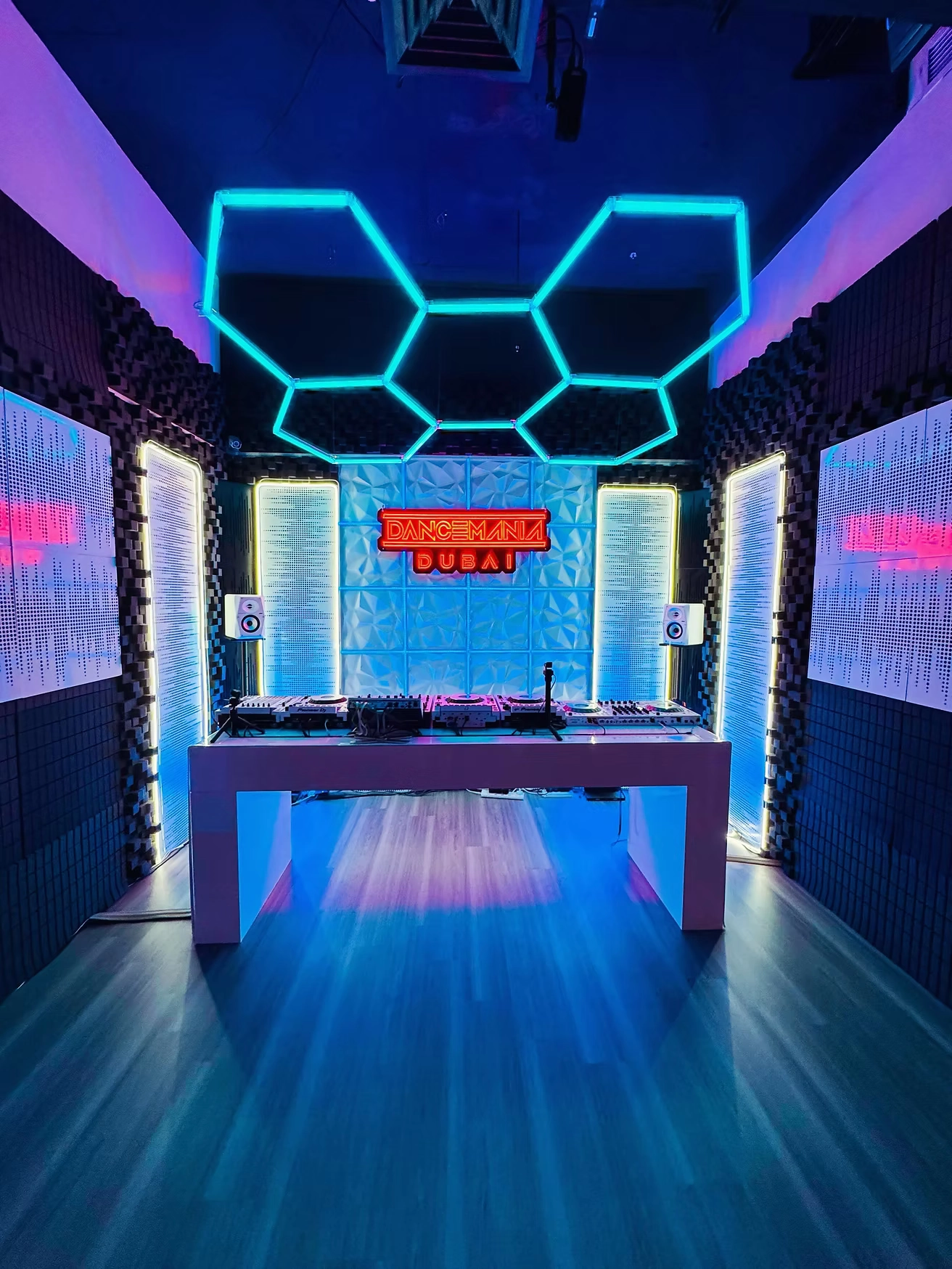
Every one-to-one session, whether you book it on a Tuesday evening or a Saturday morning, uses the same state-of-the-art, industry-current gear. There's no "weekday kit" and "weekend kit." You train on professional equipment from your very first session, full stop.
This matters more than it might initially seem. Building muscle memory on professional-grade controllers and mixers means your hands are learning the tools you'll actually use if you perform or practise at home. Spend months on inferior gear and you're essentially retraining when you finally touch the real thing.
Dancemania's equipment inventory is also kept current, updated to reflect what working DJs are actually using today, not preserved as a legacy setup from a decade ago. That commitment to staying current is part of what makes the training courses at Dancemania genuinely relevant to the modern DJ landscape.
There's a practical bonus for working adults thinking ahead. Early, consistent exposure to professional equipment means you develop an informed perspective before spending any money on your own setup. You'll know exactly what you need, and why, rather than guessing.
Why Your Instructor's Real-World Experience Changes Everything
Great equipment only tells half the story. The other half is who is standing next to you when you use it.
An instructor who is also an active DJ explains not just what a technique is, but why it matters mid-set, in a real room, in front of a real crowd. That context changes how quickly the skill sticks.
Dancemania's instructors are working music professionals with over 26 years of collective industry presence in Dubai and the UAE. They bring current knowledge of evolving trends, venue expectations, and industry standards directly into each session.
Proximity to professional networks also matters. An instructor embedded in Dubai's live music scene understands current events, booking realities, and how the industry actually moves. That makes the training immediately applicable, not theoretical.
One-to-one time opens conversations that no group syllabus covers: music selection for your audience, building a personal brand, and the practical realities of performing. If you are considering a structured DJ course package with dedicated one-to-one sessions, that depth of guidance is built into every lesson.
Understanding the Investment: DJ Course Pricing and What You're Actually Paying For
So you've found an instructor whose real-world experience you trust. Now comes the practical question: what does this actually cost, and is it worth it?
When comparing a DJ course in Dubai price, the most important comparison isn't between providers, it's between formats. Group courses price per head, which sounds affordable, but that fee buys you shared attention across multiple students. One-to-one pricing reflects something different: every minute of every session is yours.
For working adults, a cheap group course often carries hidden costs. Taking annual leave to attend a fixed daytime session, losing progress after a single missed class, and spending months on a syllabus that moves at someone else's pace, these extend your total learning time and quietly inflate what you actually pay.
Assess any DJ course in Dubai across three factors: instructor quality, equipment access, and scheduling practicality. Dancemania's one-to-one model is built to deliver on all three together, not just one at a time. The beginner DJ course packages are structured by progression level, so you pay for depth that matches your goals.
Before enrolling anywhere, ask two direct questions: can this course adapt to my work calendar, and will I train on current professional equipment? The answers will tell you whether the price reflects genuine value or simply convenience.
How to Start: Getting Into Learn to DJ Classes Around Your Career
Once you know the training model is worth investing in, the next question is practical: how do you actually begin?
Audit your week before anything else. Look at your calendar and find two or three recurring windows of 60 to 90 minutes that don't require heroic reshuffling. Early evenings, Friday mornings, a quiet Saturday slot. If those windows exist consistently, you have everything you need to start.
Reach out to Dancemania for an initial consultation. This conversation costs you nothing and commits you to nothing. The focus is your goals, your availability, and what realistic progress looks like for your schedule. It is a planning conversation, not a sales pitch.
Be honest about your starting point. Whether you have never touched a DJ controller or had a brief go years ago, the one-to-one format adjusts the curriculum to where you actually are. There is no cohort to keep pace with, only your own progression. You can also explore the beginner-level group DJ course if a social learning environment appeals to you.
Set a clear early milestone with your instructor, a target that makes progress feel tangible from the first session rather than open-ended.
Treat the first month as a test. Working adults who commit to regular weekly sessions typically find skill development faster than expected and scheduling friction lower than feared.
Your Career and Your DJ Journey Can Coexist
Once you've mapped out those weekly windows and made the initial enquiry, the hardest part is genuinely behind you.
The evidence for this isn't abstract. Dancemania's 26 years in Dubai's music industry stand as direct proof that depth and flexibility are not in conflict. Years of one-to-one instruction, delivered around real careers and real lives, have produced real DJs. That track record is the clearest answer to anyone still asking whether this is actually possible.
The low-commitment first step is a conversation. Reach out to Dancemania, share your schedule and your goals, and find out precisely what a tailored DJ course in Dubai looks like for your specific life. No pressure, no locked-in commitment, just clarity.
The adults who succeed at this are not the ones who found a perfect window in their calendar. They are the ones who chose a training model that creates one. That option is available to you right now.
Conclusion
Learning to DJ as a working adult in Dubai is not a compromise or a distant ambition. It is a structured, achievable goal with the right training model behind it.
The structural barriers that once made DJ training feel incompatible with a full-time career have been removed. Reach out to Dancemania, share your schedule and goals, and let the conversation begin.
Frequently Asked Questions
Can I really learn DJ skills with just one or two hours per week?
Yes, absolutely. Focused one-to-one training is actually more efficient than group classes because your instructor's attention is entirely on you. Research on personalized learning shows that tailored instruction improves both engagement and skill acquisition. Working adults typically progress faster than expected because they arrive with clear goals and no patience for filler. The key is consistency—regular weekly sessions, even if brief, outpace diluted group classes that meet less frequently.
What if I have to miss a session due to work or family commitments?
Missing a session doesn't set you back to zero. Unlike group cohorts where you fall behind the entire class if you miss a module, one-to-one training has no cohort to keep in sync with. You simply reschedule your next session, and your instructor picks up exactly where you left off based on detailed progress notes. This flexibility is a core structural feature of the training model, not an afterthought, which makes it ideal for professionals with unpredictable schedules.
Do I train on professional equipment or beginner-level gear?
You train on professional, industry-current equipment from your very first session, regardless of when you book it. There is no 'beginner kit' versus 'advanced kit'—every one-to-one session uses the same state-of-the-art controllers and mixers. This is crucial because building muscle memory on professional-grade gear means you won't need to retrain when you use the same equipment in real venues or at home. The equipment inventory is also kept current to reflect what working DJs actually use today.
What real DJ skills will I actually learn, beyond basic beatmatching?
A proper DJ course covers mixing techniques for smooth transitions, track selection and phrasing to read energy and build intentional sets, and EQ management to control bass, mids, and highs in real time. By the end of a structured program, you'll be ready to DJ a private event, social occasion, or take genuine first steps toward something professional. Your instructor, as an active music professional working in real venues, teaches current practice rather than outdated course outlines, so the skills are immediately applicable.
How much does one-to-one DJ training cost compared to group courses?
One-to-one pricing reflects dedicated attention—every minute is yours, whereas group course fees split instructor attention across multiple students. While a group course may seem cheaper upfront, working adults face hidden costs: taking annual leave for fixed daytime sessions, losing progress from missed classes, and extended learning time on someone else's pace. When assessing DJ course pricing in Dubai, compare across three factors: instructor quality, equipment access, and scheduling practicality. The real value comes from what you actually save in total learning time and career disruption.


Comments