Music Production in a Dubai Apartment: A Practical Guide

Most bedroom production advice assumes a spare room, a treated wall and neighbours who cannot hear you. In a Dubai apartment, that advice falls apart fast. Search for music production Dubai guidance and you will usually find tips written for houses with treated rooms, not rented flats with shared walls and a building manager who has opinions. Learning to produce here means working within those limits.
This guide is written for beginners who want a realistic path. It starts with why standard advice breaks here, then shows what you can learn on headphones: arrangement, sound design and most mixing decisions. You will learn the reference check that keeps headphone work honest, why low end needs one calibrated listening session, and how to build an apartment setup. From there, it covers when to book studio time to verify a mix, what not to buy yet, how to handle neighbours and hours, and where guided training fits into an apartment workflow.
One caution before we go: much of what circulates about permitted music hours is unverified. We will stick to what the sources actually say, and point you to where to check before you record.
Why Music Production in Dubai Apartments Breaks the Standard Advice
Most bedroom-producer guides assume a house with a treated room: monitors at ear height, first reflection points covered, volume available whenever you want it. A Dubai flat breaks all three, and not through lack of talent. Shared walls, glass and lease terms set the limit.
The constraint is monitoring, not creativity. Writing, arranging and sound design are fully learnable in an apartment. Reliable sub-bass judgement in an untreated room at neighbour-friendly volume is not, and this guide separates the two clearly.
The argument, up front: most of this work is headphone work, checked regularly on a system you do not control, with low-end decisions settled in one calibrated listening session rather than by buying gear.
Dubai housing stock varies widely, from towers and low-rise blocks to serviced apartments and shared villas. So the practical question is what your building allows and what your room does to your low end, not which monitors top a best-of list.
If you can already operate a DAW and are searching for music production in Dubai, this method works in the flat you actually rent. The city rewards it: Why Dubai Is a Serious Place to Learn Music Production.
What You Can Genuinely Learn on Headphones
Arrangement pays off most on headphones. Section length, energy mapping, transitions, drop placement and instrument count are compositional decisions that, as a working heuristic, survive translation far better than tonal ones.
Sound design follows: synthesis, sampling, layering, resampling and processing read clearly at close range, where detail, transients and stereo placement are easier to hear.
Most mixing is learnable on headphones too, from balance and panning to automation, tuning, timing and surgical EQ, provided you check every mix on another system. Measurement of more than 400 headphone models (Acoustics Today) found no correlation between retail price and frequency response, so expensive does not mean accurate.
Editing, comping and MIDI programming are effectively room-independent, which is why beginners should front-load them while their monitoring ear develops.
Buy one pair you know intimately, not three you do not. In practice, closed-back offers isolation from shared walls and traffic; open-back offers imaging and lower fatigue, but leaks, treat these as working guidance rather than specifications. The exceptions, sub-bass and translation, are covered next. For the performance side of the same skill set, see Real DJ Skills, Not Just the Basics, What You'll Actually Learn.
The Reference Check That Keeps Headphone Work Honest
Headphone work only translates if it is measured against something. Before your first session, play two or three released commercial tracks in your genre through your headphones, then return to them when your mix is finished. That single habit separates work that flatters your ears from work that survives a car or a club.
Keep a written reference list with notes on each track: sub level, top-end brightness, how far the vocal sits ahead of the kick. Document what you heard at the time; memory drifts within hours. This is the same documentation discipline that Step 1: Audit Every Way Your Business Uses Music asks of anyone using music professionally.
Check every mix on at least one system you do not control: car stereo, laptop or phone speaker, Bluetooth speaker, a friend's setup. Each reveals something different, and none becomes your decision-making reference.
Level-match against your reference and take breaks; judging tone at the wrong loudness is the most common way headphone mixes go wrong. The traps outlined in the headphone section, bass flattery and stereo exaggeration, are exactly what a reference track will expose.
None of this settles sub-bass, though.
What Headphones Cannot Settle: Low End and One Calibrated Session
Those exceptions are what this section is about.
Controlled judgement depends on controlled reproduction: ITU-R BS.1116-1 exists precisely because small impairments need rigorous conditions, and serious listening rooms are measured and treated rather than assumed neutral (Graz acoustic study).
Dubai flats make this harder. As a working heuristic, near-square footprints, glass, hard floors and bare walls generate standing waves and nulls, so you mix around problems you cannot hear instead of fixing the ones that exist.
The fix is one calibrated listening session, not a permanent studio. Bring two reference tracks and your mix, listen on a known system at a known level, and note corrections in decibels. Settle low end there first, then apply those numbers on headphones. Never re-engineer bass in a room you know you cannot trust. Spectrum analysis is a second opinion, not a substitute for listening.
A Workable Apartment Setup for Music Production in Dubai
With that calibration work done, bring the lessons back to the setup you already have. Add an audio interface only when you need to record a microphone or instrument.
In an untreated room, position your desk off-centre, not dead centre. Keep the layout as symmetrical as the flat allows relative to the side walls, stay away from glass and hard corners, and avoid the exact middle of a square room. Treat these as practical heuristics.
Heavy curtains, rugs, a bookshelf, a sofa, and a mattress against a shared wall are practical measures, not acoustic treatment, but they reduce reflections and neighbour disturbance modestly. Use headphones for late sessions.
Keep unbalanced cables short. Avoid daisy-chained power strips, which can introduce hum, and diagnose ground loops before blaming your interface.
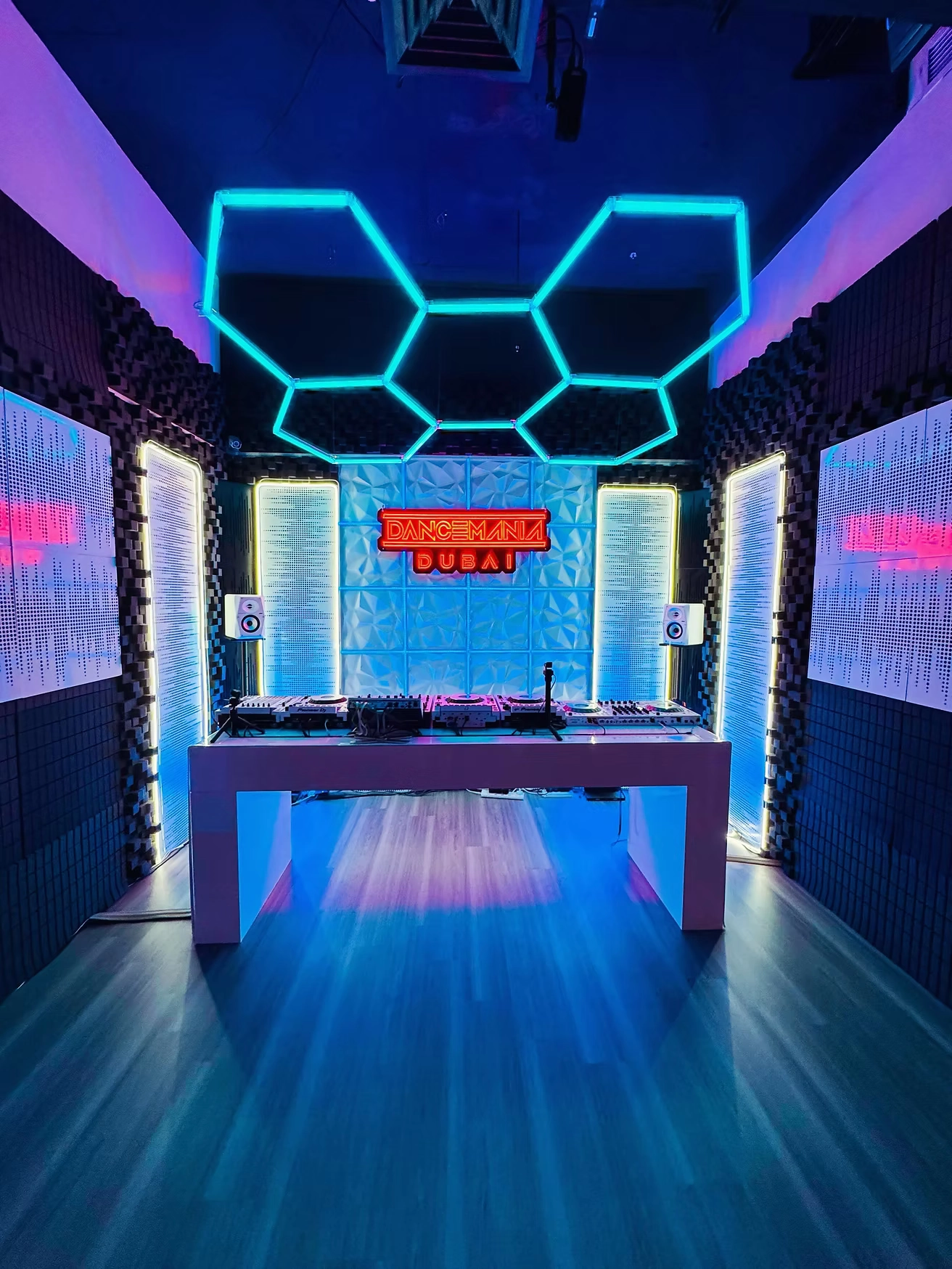
If you use monitors, treat them as a second check, not your decision-making reference. In an untreated room, they will mislead you. For a session where a calibrated room is the point, consider a DJ studio session in Dubai.
When to Book Studio Time to Verify a Mix
Book studio time when the open decision is low end, translation or critical listening. Do not book it to write or arrange; that is apartment work you would be paying studio rates to do badly.
Vocal recording and comping also belong there, because they need a quiet room and a clean microphone chain, which is what a vocal recording session provides.
Arrive with a finished arrangement, a mix bounced at a matched level, and written questions: sub level, vocal brightness, mono compatibility, large-system translation. EBU R 128 recommends normalising programme loudness to a Target Level of -23.0 LUFS, a broadcast standard worth knowing, though not a general bedroom-mixing target. Wait if the arrangement still changes every session, or if you cannot yet describe the fault in words.
Prepare properly: reference tracks loaded, your mix bounced at a matched level, stems ready for obvious on-the-spot fixes, and a way to capture revisions so the answers come home with you.
Rates and booking norms vary. Ask the studio directly rather than trusting prices you cannot verify.
What Not to Buy Yet
Treatment before diagnosis. Panels and bass traps bought before you know which frequencies your room loses or doubles money the wrong surface. Acoustics research shows low-frequency control is costly and narrow-band, while treatment above a few hundred Hz is comparatively straightforward: a stated heuristic, not a diagnosis.
Large monitors or a subwoofer. The most common beginner mistake. In an untreated flat they will not deliver the low-end accuracy you are paying for, and they create the neighbour problem this guide exists to avoid. Floyd Toole calls the idea that calibration repairs unspecified rooms "an enticing marketing story" (he worked for Harman, a manufacturer).
Expensive reference headphones, or two or three pairs at once. Learn one pair deeply before you trust it as a comparison tool.
High-end preamps, outboard compressors, summing mixers, "vintage-style" hardware. Wasted until your monitoring and your ears can reveal what they are doing.
Template and plugin bundles. Bought faster than you can use them. Judge them on independent reviews and audio-engineering sources, never retailer copy. If you are weighing structured help instead, read why most people delay signing up for music production lessons.
Neighbours, Hours and Keeping the Peace
You have deferred the gear. Now manage the room you actually have.
No verified residential music-hours rule exists in Dubai: DDA Circular 613 covers construction contractors and consultants, not home studios, so ignore generic online hours claims and confirm any circular is current before citing it. Start with your own building rules, your developer or community guidance, and current Dubai Municipality guidance. Dubai Municipality's contact centre is on 800900.
Keep monitor sessions at conversational levels, move late work to headphones, and isolate desk and monitors from floor and shared walls with foam or rubber pads. Warn a neighbour before a long session rather than apologising afterwards. As a practical measure, reducing your sub level is generally the easiest way to lower the noise your neighbours notice; structural bass transmission is harder to block than high-frequency sound. Never conceal the noise. That respect for a shared space is the discipline live work demands too, as covered in DJ lessons Dubai artists can use beyond the studio.
The goal is a workable relationship and a room you can keep working in.
Where Guided Training Fits Into an Apartment Workflow
If quiet hours limit your monitor time, guided training is where that verification can happen. That is where guided training resolves the tension: a room with studio monitoring and an experienced instructor for the decisions your flat cannot settle. It applies the same one-to-one format described in How Dancemania Dubai Structures Its DJ Training.
The benchmark for booking time is a specific low-end or translation question you cannot answer at your desk, not equipment lists or studio specifications.
If you want structured one-to-one help with the monitoring and mixing decisions a flat makes hard, this is one Dubai option for learning music production.
Conclusion: Your First Three Moves
Your method is settled. Here are the moves to make this week.
1. Learn one pair of headphones properly. Choose a pair you trust and build a written reference list of two or three commercial tracks in your genre: sub level, top-end brightness, vocal position. Do this before you buy anything else.
2. Book one calibrated listening session. Arrive with your bounced mix, your references and specific written questions. Leave with corrections in decibels, not impressions. Settle the low end there, then apply that information back on headphones.
Everything else happens at your desk. Arrangement, sound design and most mixing stay at your desk, only low-end and translation questions justify studio time.
3. Buy nothing else yet. Defer monitors, treatment and extra gear until you can name the exact problem.
And check your building's rules before any late session.
Frequently Asked Questions
Why does standard bedroom production advice break down in a Dubai apartment?
Standard advice assumes a house with a treated room, monitors at ear height, covered first reflection points and volume available whenever you want it. A Dubai flat breaks all three because of shared walls, glass and lease terms. The constraint is monitoring, not creativity: writing, arranging and sound design are fully learnable in an apartment, while reliable sub-bass judgement in an untreated room at neighbour-friendly volume is not.
What can I learn on headphones when producing music in an apartment?
Arrangement pays off most on headphones, including section length, energy mapping, transitions, drop placement and instrument count. Sound design (synthesis, sampling, layering, resampling and processing) also reads clearly at close range. Most mixing is learnable on headphones too, provided every mix is checked on another system. Editing, comping and MIDI programming are effectively room-independent, so beginners should front-load them.
How do I keep headphone mixing honest?
Before your first session, play two or three released commercial tracks in your genre through your headphones and return to them when your mix is finished. Keep a written reference list with notes on sub level, top-end brightness and how far the vocal sits ahead of the kick, documenting what you heard at the time. Check every mix on at least one system you do not control, such as a car stereo, phone speaker, Bluetooth speaker or a friend's setup. Level-match against your reference and take breaks.
When should I book studio time, and what should I bring?
Book studio time when the open decision is low end, translation or critical listening, or for vocal recording and comping, which need a quiet room and clean microphone chain. Do not book it to write or arrange. Arrive with a finished arrangement, a mix bounced at a matched level, stems ready for on-the-spot fixes, reference tracks loaded and written questions about sub level, vocal brightness, mono compatibility and large-system translation. Ask studios directly about rates and booking norms.
What should I avoid buying when starting out, and what about permitted music hours?
Avoid buying treatment before you know which frequencies your room loses or doubles, large monitors or a subwoofer, expensive reference headphones or several pairs at once, high-end preamps and outboard hardware, and template or plugin bundles you cannot yet use. Regarding hours, the post states that no verified residential music-hours rule exists in Dubai. DDA Circular 613 covers construction contractors and consultants, not home studios. Check your building rules, your developer or community guidance and current Dubai Municipality guidance (contact centre 800900) before recording.


Comments